
From a Greenwich Arrest to Stamford Court
Greenwich is a town in Connecticut. The state does not run county jails or county district attorneys. So a Greenwich arrest does not create a county court record. It feeds into the statewide court system instead. After Greenwich Police process a person, two Court Liaison Officers from the Detective Division move the case forward. They process arrestees through the court system, serve arrest warrants, transport people to and from court, and make sure court documents are completed and filed. That step turns a street arrest into an open court case with a docket number.
The prosecutor then reviews the file and decides what charges to bring. In Connecticut that prosecutor is a State's Attorney, not a county DA. Greenwich falls under the Office of the State's Attorney for the Judicial District of Stamford/Norwalk. The case itself is heard at the courthouse in Stamford. So the booking happens in Greenwich, but the court record opens in Stamford. The flow runs in a simple line: arrest, police and Court Liaison processing, prosecutor review, charges filed, and a court case that you can then search by name or docket number.
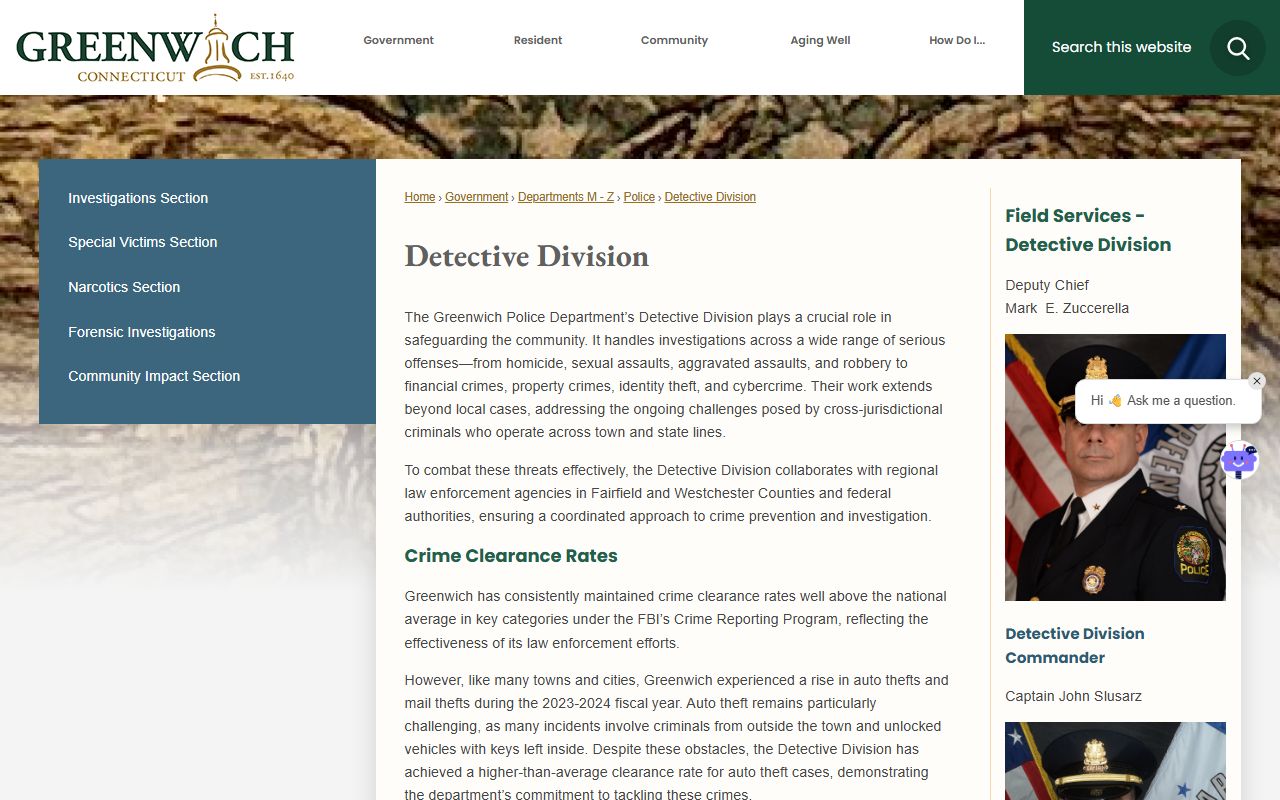
The Greenwich Detective Division page lists the Court Liaison duties that bridge the police side and the court side.
Below is the Greenwich Detective Division page, which describes how arrestees are processed through the court system. The image links to that official page.
View the Greenwich Detective Division and Court Liaison page.
Those liaison officers are the human link that carries a Greenwich arrest into the court record that you later look up online. Note: the booking and custody side of an arrest lives on a different page, so use jail inmate records for custody lookups and jail roster mugshots for booking photos.
Part A and GA No. 1 Stamford Court Roles
Not every Greenwich case goes to the same courtroom. Connecticut splits criminal work by how serious the charge is. The most serious felonies go to Part A. Everything else, including most misdemeanors and motor vehicle matters, goes to a Geographical Area court, also called Part B. For Greenwich, the Part B court is GA No. 1 in Stamford. Knowing which part holds the case tells you where to expect the court record and which office to call about it.
The split is set by the Division of Criminal Justice. The Part A office prosecutes class A and class B felonies, the most serious offenses, for every town in the district. GA No. 1 Stamford handles class C, D, and E felonies, misdemeanors, infractions, and motor vehicle offenses for Stamford, Darien, and Greenwich. Both parts feed the same statewide court record system, so a defendant search can return either kind of case.
| Court Part | What It Handles |
|---|---|
| Part A, Stamford Superior Court | Class A and class B felonies, the most serious offenses, for all towns in the Stamford/Norwalk district, including Greenwich. |
| GA No. 1 Stamford (Part B) | Class C, D, and E felonies, misdemeanors, infractions, and motor vehicle matters for Stamford, Darien, and Greenwich. |
A class is a label for how grave a crime is and how long a sentence it can carry. Class A felonies are the most serious. Infractions are minor offenses, often handled like a ticket. Note: a serious Greenwich felony arrest may show up as a Part A case in Stamford, while a low-level charge stays in GA No. 1.
Search Greenwich Court Records After Arrest
Once a case is open, the Connecticut Judicial Branch is where the court records live. The branch runs free online tools for criminal and motor vehicle cases. You can search pending cases that are still moving through court, past convictions, and the daily docket of cases scheduled for a given day. There is no login and no fee. The right tool depends on whether the case is still active, already decided, or set for court that day.
- Open the Criminal and Motor Vehicle Case Look-up hub at the Connecticut Judicial Branch.
- Pick the right tool: pending cases by defendant or docket number, convictions by defendant or docket number, or the daily docket by court or defendant.
- Enter the last name and any other details the form allows, then run the search.
- Open the matching case and read the docket number, the filed charges, the court location, and the current status.
The hub links each search separately, so it helps to know the exact addresses. Pending cases by defendant use the pending case search by defendant, and pending cases by docket number use the pending case search by docket number. Decided cases use convictions by defendant or convictions by docket number. The day's calendar uses the daily docket by court or the daily docket by defendant.
The hub page sits at the front of all these tools and explains what each one covers.
The screenshot below shows the Connecticut criminal and motor vehicle case look-up hub where these searches begin.
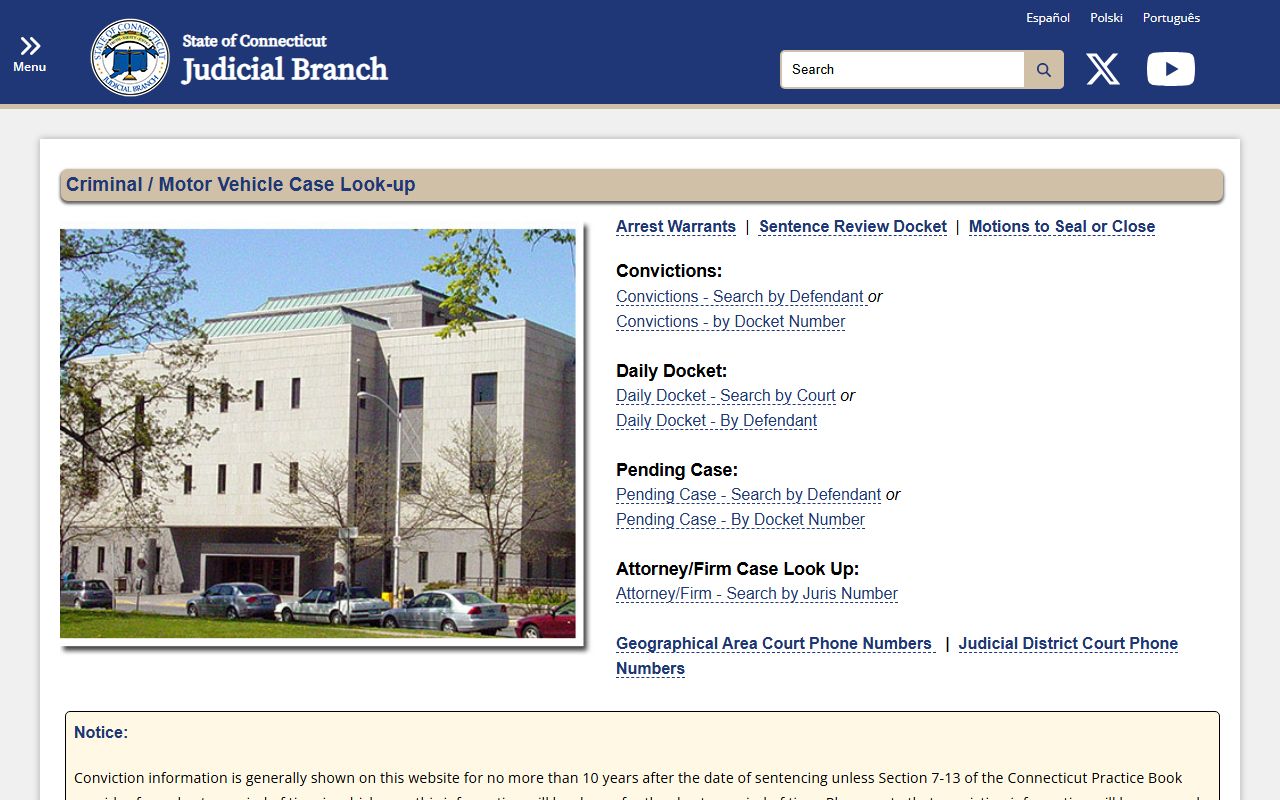
From that hub you can reach every pending, conviction, daily docket, and warrant search the branch offers.
Greenwich Pending Case Search Fields
The pending case search by defendant is the main tool for an open Greenwich case. It uses a short form. Only the last name is required, and you can narrow the search with a first initial, a birth year, and a court location. For Greenwich, choose Stamford Geographical Area 1 or the Stamford Judicial District in the Court Location dropdown. The CategoryType lets you limit results to criminal or motor vehicle matters.
| Field | Type | Required | Notes |
|---|---|---|---|
| Last Name (begins with) | text | Yes | Maximum 60 characters. |
| First Initial | text | No | Maximum 1 character. |
| Birth Year | text | No | Maximum 4 characters. |
| Year Range + or - | text | No | Maximum 1 character, widens the birth year. |
| Court Location | dropdown | No | Includes Stamford GA 1 and Stamford JD for Greenwich, plus statewide courts. |
| CategoryType | dropdown | No | Criminal; Motor Vehicle; Referred for MV/Boat License or Registration Suspension. |
The form is plain, but the results carry real weight.
The image below shows the pending case search by defendant form with these fields.
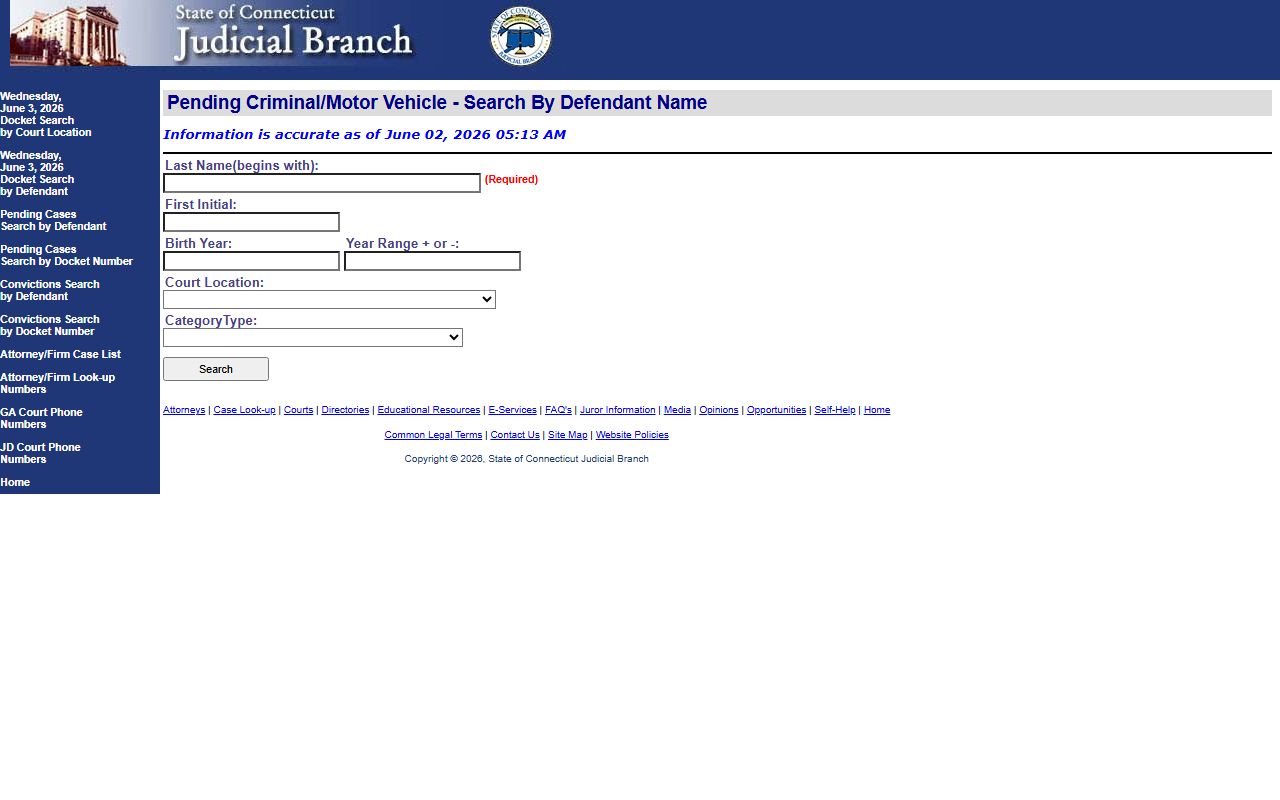
A matching result opens a case page with the docket number, the filed charges, the court location, and the next court date.
Daily Docket, Pending Case, and Conviction Records
The three search types answer different questions. The pending case search shows cases that are still active. The conviction search shows cases that ended in a guilty result. The daily docket shows what is scheduled in a courtroom for the current date. The daily docket by defendant is the simplest of all. It asks only for a last name, and the page notes it covers the current date and does not include add-on dockets.
The Judicial Branch posts important limits on what shows up. Conviction information is generally shown online for no more than ten years after sentencing, unless Connecticut Practice Book Section 7-13 sets a shorter period. Youthful offender cases, juvenile cases, and infraction or violation convictions are not shown at all. Criminal history information can also change daily because of erasures, corrections, pardons, and other updates. So a record you find today may read differently next week.
A docket is the official list of events and filings in a case. Note: a case that no longer appears in the pending search may have closed, been erased, or aged out of the conviction display window.
Charges Can Change After Prosecutor Review
The charge listed at arrest is not always the charge filed in court. When Greenwich Police make an arrest, they record an allegation. The State's Attorney then reviews the file and decides what to actually file. That charge can be amended, reduced, added to, dismissed, or nolled. A nolle prosequi, often shortened to nolle, means the prosecutor decides not to go forward with a charge for now. So the court record is the better source for the real charges, the court dates, and the outcome.
This is why an arrest record and a court record can disagree. Greenwich has no public roster of booking charges, so the filed court charges are the reliable version. The status terms below appear often in Connecticut court records.
| Status | What It Means |
|---|---|
| Pending | The case is still open and moving through court; no final outcome yet. |
| Amended or Reduced | The prosecutor changed a charge, often to a lesser offense, after review. |
| Dismissed | The court ended the charge without a conviction. |
| Nolle Prosequi | The prosecutor declined to continue the charge, at least for now. |
Reading the status tells you where the case stands and whether a charge survived prosecutor review.
Charge vs Conviction in Greenwich Records
An arrest and a charge are accusations. A conviction is a final result. These are not the same thing, and the court record keeps them separate. A person can be arrested, charged, and still never convicted. Treating a charge as proof of guilt is a common and serious mistake. The comparison below shows the difference each carries.
| Charge | Conviction | |
|---|---|---|
| Stage | Accusation after an arrest | Guilty verdict or guilty plea |
| Proof Needed | Probable cause | Proof beyond a reasonable doubt |
| Outcome Set | No, the case is still open | Yes, the case is decided |
| Where It Shows | Pending case search | Conviction search |
Because a charge is only an accusation, the court record may later show it dismissed, nolled, or reduced. Note: a Greenwich arrest that produced a charge does not mean the person was convicted, and the conviction search is the place to confirm a final result.
Bond and Release After a Greenwich Arrest
After an arrest, a bond often decides whether a person waits in custody or goes home before court. Bond is the condition for release. Connecticut uses several kinds. A promise to appear releases a person on a written promise to come to court, with no money up front. A cash or surety bond can require payment or a bail bond agent, depending on the conditions set. A non-surety bond sets an amount that only becomes owed if the person fails to appear. A no-bond hold means paying a standard bond will not release the person.
A hold can come from another warrant, a probation hold, a court order, or a detainer from another agency such as federal or immigration authorities. Any of these can keep someone in custody even when a local charge has a bond. Greenwich Police did not publish a local bail-posting page with accepted payment methods or counter hours in the sources reviewed. Because of that gap, call Greenwich Police or the relevant court or Department of Correction facility before traveling with payment.
| Bond Type | How It Works |
|---|---|
| Promise to Appear | Release on a written promise to appear in court, with no payment up front. |
| Cash or Surety Bond | Payment or a bail bond agent may be required, based on the conditions set. |
| Non-Surety Bond | An amount that becomes owed only if the person fails to appear. |
| No-Bond Hold | Custody status where paying a standard bond will not release the person. |
For case status after a filing, the Judicial Branch lookup is the right tool; for someone moved into state custody, the Department of Correction inmate search is the place to check.
Greenwich Warrants and Orders to Incarcerate
Some arrests start with a warrant. A warrant is a court order that authorizes an arrest or directs custody. Connecticut Judicial Branch runs a public search for certain warrants tied to court cases. The page is titled Arrest Warrants for Violation of Probation or Failure to Appear, and Orders to Incarcerate. A VOP warrant covers a violation of probation. An FTA warrant covers a failure to appear in court. An order to incarcerate is a court order directing custody. You can search by name, town, court location, or any combination.
The town dropdown is large and includes both GREENWICH and OLD GREENWICH. The court location dropdown includes Stamford GA 1 and the Stamford Judicial District for local matters. The page also shows a timestamp for how current the data is.
| Field | Type | Required | Notes |
|---|---|---|---|
| Last Name | text | No, if another filter is used | At least the first two letters. |
| Town | dropdown | No | Statewide list; includes GREENWICH and OLD GREENWICH. |
| Court Location | dropdown | No | Includes Stamford GA 1, Stamford JD, and statewide courts. |
The warrant search is available directly from the Judicial Branch.
The image below shows the Judicial Branch warrant search with the town and court filters.
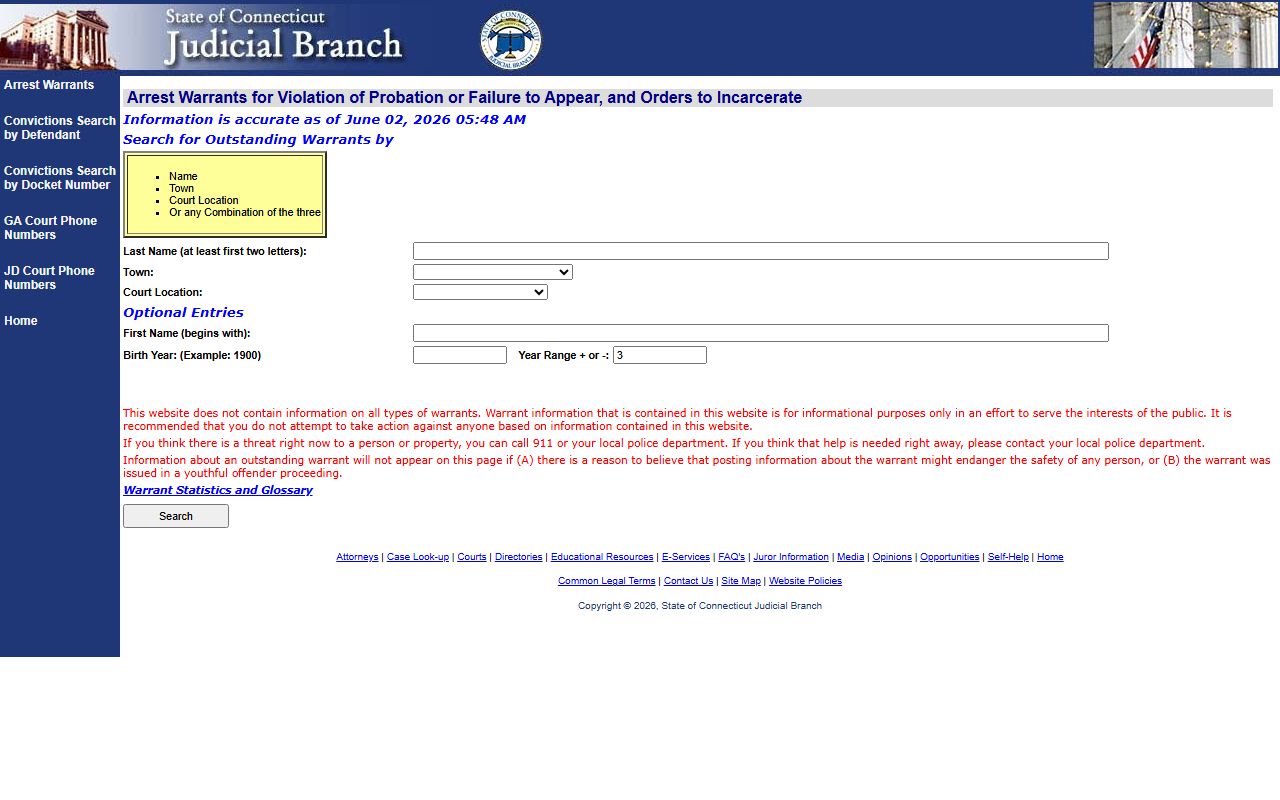
For immediate warrant questions or surrender steps, call Greenwich Police or the court rather than relying on a web search alone, since the Detective Division Court Liaison Officers serve warrants and handle extraditions.
Stamford/Norwalk State's Attorney Contacts
The prosecutor who handles Greenwich cases sits in Stamford. The Office of the State's Attorney for the Judicial District of Stamford/Norwalk covers Darien, Greenwich, New Canaan, Norwalk, Stamford, Weston, Westport, and Wilton. Paul J. Ferencek is the State's Attorney, appointed effective May 1, 2020. For GA No. 1 matters, which include most Greenwich misdemeanors and motor vehicle cases, the Supervisory Assistant State's Attorney is Suzanne M. Vieux. When an online court search comes up short, the office is the place to ask about a filed case.
Office of the State's Attorney, Judicial District of Stamford/Norwalk
123 Hoyt Street
Stamford, CT 06905
Judicial District phone: 203-965-5215
GA No. 1 phone: 203-965-5255; fax 203-965-5793
Email: conndcj@ct.gov
The State's Attorney page explains the office's role and the towns it serves.
The screenshot below shows the Stamford/Norwalk State's Attorney page that covers Greenwich.
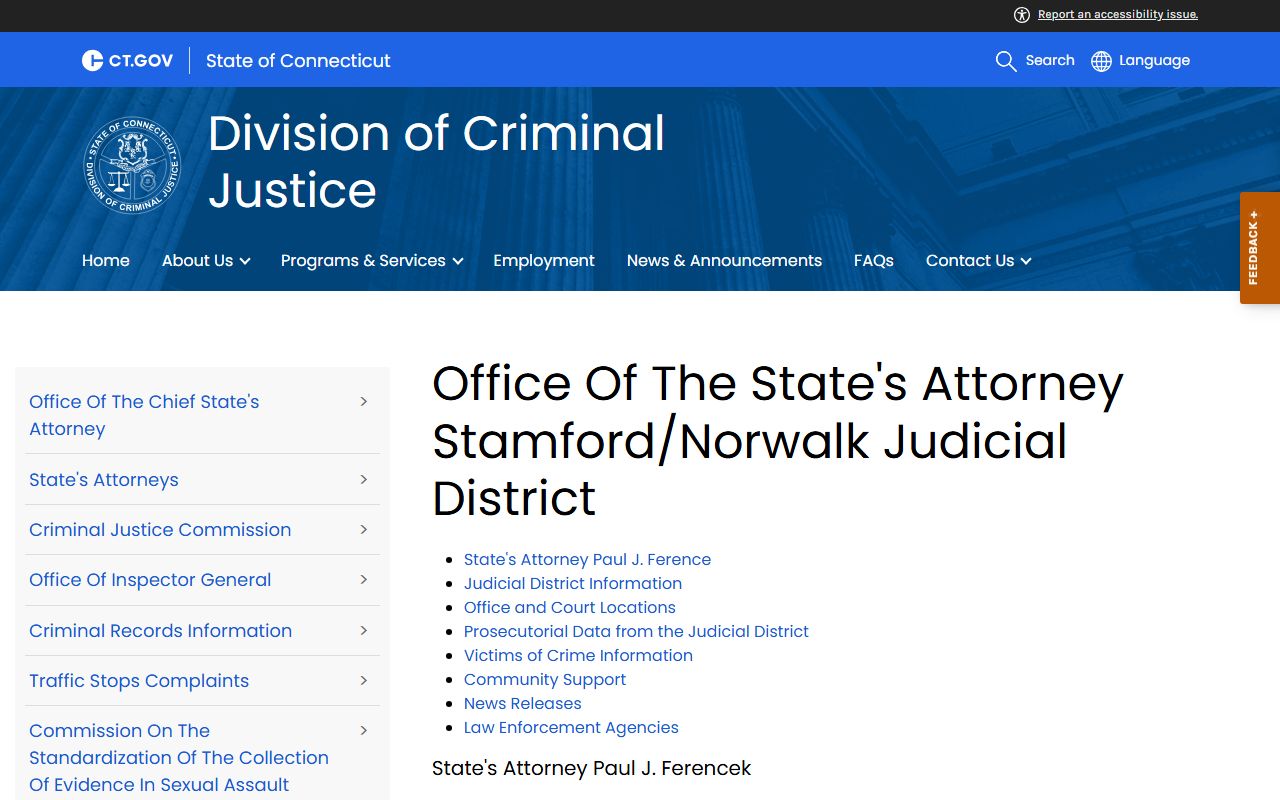
That office decides the filed charges that become the court record you search.
Erasure, Juvenile, and Youthful Offender Limits
Some court records after an arrest are not public. Other states talk about sealed or expunged records. Connecticut uses a different concept called erasure. Under Connecticut General Statutes Sec. 54-142a, certain records can be legally erased from public access after a dismissal, a nolle that has run its course, an acquittal, a pardon, or another eligible outcome. An erased record is not treated like an ordinary public record. So a case that once appeared online can drop off after erasure.
The Judicial Branch already limits what the online tools display. Youthful offender cases, juvenile cases, and infraction or violation convictions are not shown. Conviction information generally shows for no more than ten years after sentencing, unless the Practice Book sets a shorter period. So missing court records do not always mean a missing case. The record may be erased, restricted, or simply outside the display window.
The table below adapts the sealed versus expunged idea to how Connecticut law actually works.
| Restricted Online Display | Erasure (Sec. 54-142a) | |
|---|---|---|
| What Happens | The case is not shown in the public online search. | The record is legally erased from public access. |
| Common Reason | Juvenile, youthful offender, infraction, or past the display window. | Dismissal, acquittal, eligible nolle, or pardon. |
| Still a Public Record | Often yes, but not in the online tool. | No, erased records are handled apart from ordinary public records. |
Note: a Greenwich case that vanishes from the online search may have been erased under Sec. 54-142a rather than hidden by error.
How Police Records and Court Records Differ
Police records and court records are two different things after an arrest. A police record sits with Greenwich Police and may include the arrest report, releasable photos, or body-worn camera media. A court record sits with the Judicial Branch and holds the filed charges, court dates, and the outcome. To get a police record, file a request with the Greenwich Police Records Section. To read the filed charges, use the court case search.
Connecticut law sets the public-access frame for both. Under the Freedom of Information Act, Sec. 1-210 makes public records available unless an exemption applies, and Sec. 1-212 governs copies and fees. Sec. 1-215 makes a record of arrest a public record from the time of arrest, subject to listed redactions. Those redactions can shield juvenile records, victim and witness identity, medical details, and open investigations. So a police record request may come back partly redacted, while the court record shows the filed charges in full.
Important: This is a private reference site and not a consumer reporting agency under the Fair Credit Reporting Act, so its information may not be used for credit, employment, tenant, or insurance screening.