
Are Greenwich County Mugshots Public
No. There is no official Greenwich County mugshot gallery, no daily booking-photo feed, and no recent-bookings page run by a local agency. Researchers find the same gap that anyone else does. Greenwich Police process people who are arrested at the Public Safety Complex, but no public custody roster or mugshot log was located on any official Greenwich page. That is the core fact behind the search.
The reason is structural. Connecticut does not run a county-sheriff jail system the way many other states do. The Federal Bureau of Justice Statistics treats Connecticut as a combined prison-jail state, so a "Greenwich County jail roster" is not a real channel. Greenwich is a town in Fairfield County, and formal custody passes to the Connecticut Department of Correction once a person moves beyond police processing.
Public access does exist, just not as a photo gallery. Arrest records are public from the time of arrest under state law. A booking photo can sometimes be obtained through a police records request, when no exemption blocks it. The honest summary is that arrest information is open, while an online Greenwich mugshot feed simply does not exist.
Note: A current incarceration does not mean a conviction, since Connecticut holds many accused people who are still awaiting trial.
Greenwich Arrest Records and Booking Photos
Connecticut's Freedom of Information Act sets the rule for arrest records. Under Section 1-215, the record of an arrest is a public record from the time of the arrest. That access is broad, but it is not a mugshot roster. It defines a specific set of facts the public may obtain, subject to redactions and a few sealed exceptions.
The Freedom of Information Commission spells out what "record of the arrest" means. It covers the arrested person's name, race, and address. It covers the date, time, and place of the arrest, plus the offense charged. For a warrant arrest it includes the warrant application or affidavit. For a warrantless arrest it includes the official arrest, incident, or similar report, unless a judge has sealed that affidavit or report. The fields below show what the arrest record itself contains under Section 1-215.
| Record of Arrest Field | What It Shows |
|---|---|
| Name | The full name of the person who was arrested. |
| Race | The race of the arrested person as recorded. |
| Address | The arrested person's address. |
| Date, Time, and Place of Arrest | When and where the arrest took place. |
| Offense | The offense for which the person was arrested. |
| Warrant or Incident Report | The warrant application and affidavit for a warrant arrest, or the arrest, incident, or similar report for a warrantless arrest, unless a court has sealed it. |
A booking photo is not named in that list. During a pending prosecution, the statute does require other public records that document or depict the arrest or custody to be disclosed, unless another exemption applies. That language supports asking for a booking photo. It does not turn the photo into something posted online by default. FOIA is short for Freedom of Information Act, the law that makes most government records open to the public.
How to Request a Greenwich Booking Photo
When a booking photo is not online, the legitimate route is a records request to Greenwich Police. The town's General Services Division handles these requests. A photo can be released only when no exemption blocks it, so the outcome depends on the case. The steps below follow the official Greenwich records process.
- Check whether the person is in Connecticut DOC custody first, using the state inmate search at the CT DOC inmate search page. Do not expect a Greenwich mugshot feed.
- Submit a records request to Greenwich Police through the online records request form or the printable form, and identify the photo or record you want.
- Include the CFS case number if you have it. The number starts with a two-digit year, then digits, for example 20-12345. If you have no number, give the full name, date of birth, and the date and location of the incident.
- Allow 5 to 7 business days for ordinary processing. Larger or more complex requests can take longer.
- Pay the fees before release. Greenwich charges $0.50 per page, $19.50 per CD or DVD, and $26 per flash drive. Records are not released until payment is received.
- Understand the withholding reasons. A photo may be redacted or denied when it is tied to an open investigation, a juvenile matter, victims or witnesses, sealed or erased cases, or other protected information.
Greenwich Police accept any written request, though the form is encouraged. Mail or hand delivery goes to the Records Section at the Public Safety Complex. The records counter is open Monday through Friday, 8:30 a.m. to 4:15 p.m. The general records process and fee schedule appear on the General Services Division page.
The Greenwich Police online records request form lays out the fields a requester fills in. A look at that form helps before submitting.
The online intake is shown on the Greenwich Police online records request form.
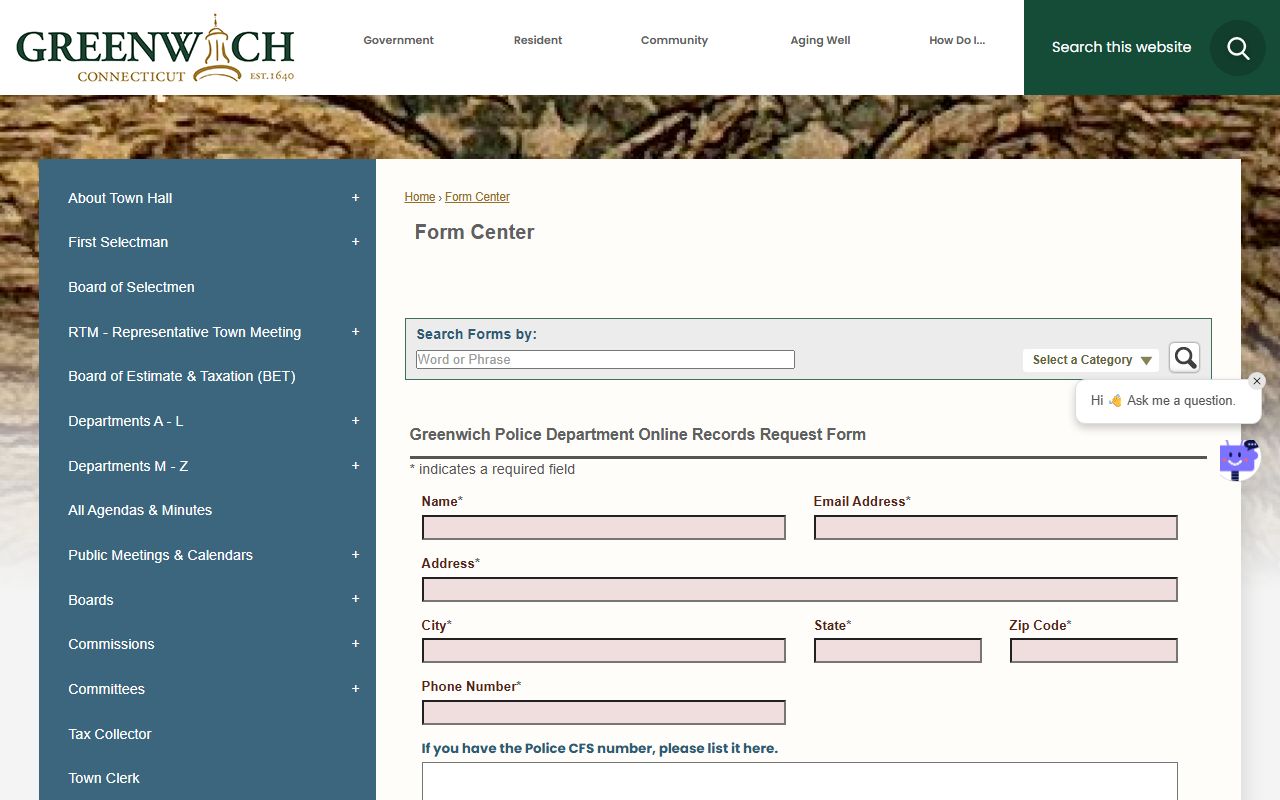
The form asks for the requester's name, contact details, the CFS number if known, and a delivery choice of mail, pickup, or email. Filling those fields fully speeds the search for a Greenwich booking photo or report.
The Records Form and Photo Redactions
The printable Greenwich records form includes an official-use section that the records unit completes. It lists "Photos" as a media output category, which confirms that a photo can be part of a release. It also lists the reasons a record or part of a record may be held back. These redaction and denial categories show what the unit screens for before sending anything out.
- Personal identifying information and witness statements.
- Identity of informants, witnesses, or minor witnesses.
- Juvenile information and juvenile records.
- Medical information and sex-assault victim identifying details.
- Investigatory techniques and COLLECT or NCIC data.
- Open investigations, no public record, and uncorroborated or unfounded allegations.
These categories matter for a booking-photo request. A photo tied to a sealed file, a juvenile case, or an active investigation may be withheld even though arrest records are generally public. Redaction means blacking out or removing protected details before release. The screening explains why two similar requests can return different results.
The Greenwich Crime Data Portal
Greenwich does publish a Crime Data Portal, and people sometimes mistake it for an arrest roster. It is not one. The portal shows reported incidents and law-enforcement activity, and the data refreshes daily around 7 a.m. It is a transparency tool, not a custody list, and it carries no booking photos.
The portal's own warnings make the limits clear. Details may be withheld or generalized to protect active investigations and victim privacy. The data is preliminary. It may not include every incident, arrest, or record that Greenwich Police maintain. So the portal cannot confirm whether a specific person is in custody, and it should not be read as an arrest record.
The portal and its disclaimers appear on the Greenwich Crime Statistics page.
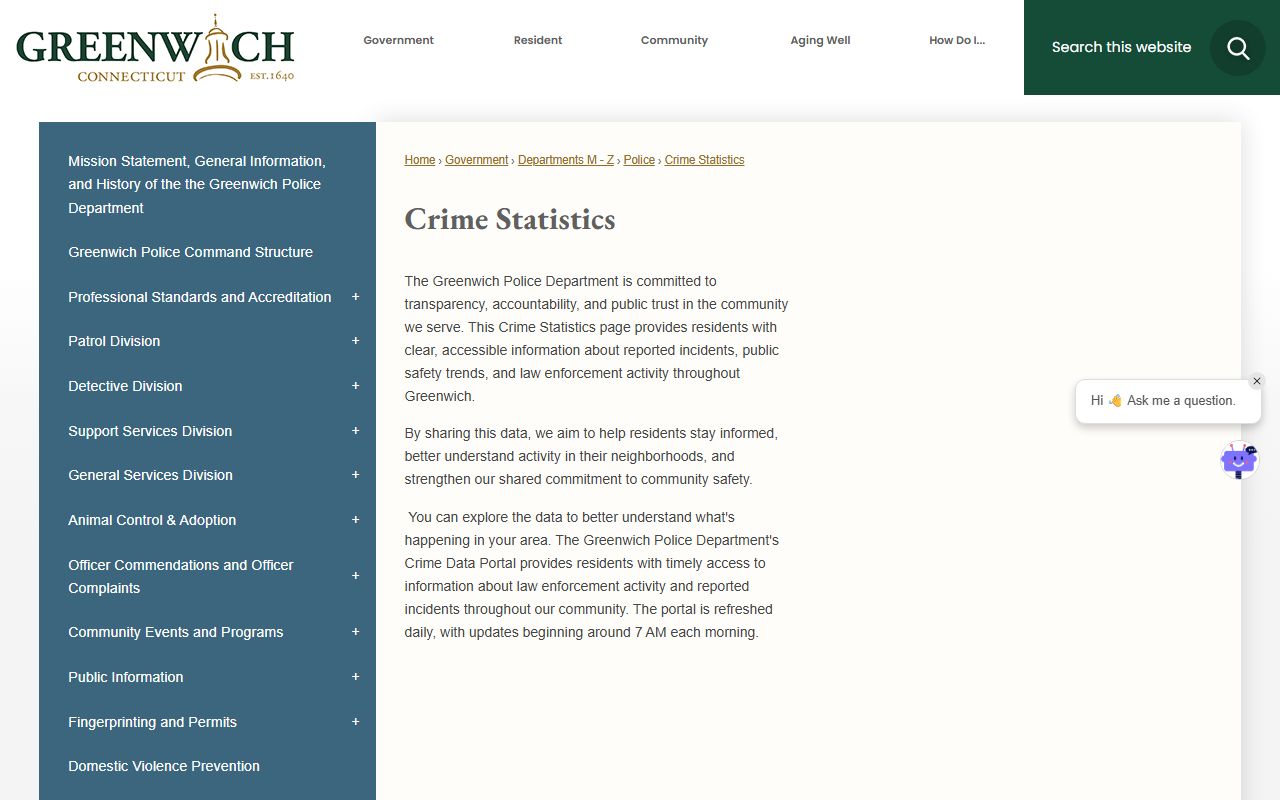
The page presents incident statistics for the town, not a person-by-person booking log. For a specific arrest record or photo, the records request remains the correct channel rather than the portal.
Connecticut Law on Arrest Record Access
Several Connecticut statutes shape whether a Greenwich booking photo or arrest record can be released. None of them creates a separate public mugshot roster. Instead they set the public-records baseline, the copy fees, and the limits that protect certain people and cases. The callout gathers the key sections in one place.
Key Statutes:
Connecticut General Statutes Sec. 1-215 makes the record of an arrest a public record from the time of arrest, with listed redactions and a few sealed exceptions. The Freedom of Information Commission page on Sec. 1-215 defines the record of the arrest.
Connecticut General Statutes Sec. 1-210 is the general public-records law; records are open unless a federal law or state statute creates an exemption. Subsection (b)(3) lets agencies withhold certain crime-detection and investigation records, and the Commission page on Sec. 1-210 lists the exempt categories.
Connecticut General Statutes Sec. 1-212 governs copies of public records and the fees agencies may charge, detailed on the Commission page on Sec. 1-212.
Connecticut General Statutes Sec. 54-142a is the erasure law; certain dismissed, nolled, acquitted, or pardoned records are erased and no longer treated as public.
Section 1-210(b)(3) is the part that most often limits a photo request. It permits withholding records that would reveal an unknown informant or witness, a minor witness, a signed witness statement, juvenile arrest records, certain victim identity or address details, or uncorroborated allegations. A separate provision, Section 1-210(b)(18), lets the Commissioner of Correction hold back correctional records when release could create a safety, escape, or disorder risk.
Fees follow Section 1-212. Other public agencies may generally charge up to $0.50 per page, and prepayment can be required when the estimate runs high. Greenwich's local records page lists that $0.50-per-page rate along with media fees, so the town's schedule lines up with the statute.
Erased and Sealed Greenwich Records
Some records leave public view entirely. Connecticut's erasure law, Section 54-142a, removes certain criminal records from public access. Cases that are dismissed, nolled, ended in acquittal, or pardoned may qualify. Nolle, short for nolle prosequi, means the prosecutor has decided not to pursue a charge. Once a record is erased, it is no longer handled like an ordinary public record, and any booking photo tied to it should not be released.
Section 1-215 itself carves out these files. It excludes juvenile arrest records, records erased under the erasure chapter, and investigative files compiled for the investigation. So an erased Greenwich case is doubly protected. The arrest-record statute does not reach it, and the erasure statute affirmatively shields it. Charge and court outcomes that drive erasure are tracked through Connecticut court records after a jail arrest.
That framework is also the answer to mugshot removal. The legitimate routes are the agency that holds the record, the court's erasure and sealing rules, or a lawyer. People should not pay a third-party site to "remove" a photo. The way a photo stops being a releasable public record is through the records process itself, not a commercial service.
Note: Connecticut criminal-history information can change daily because of erasures, corrections, pardons, and other modifications, so a record's status is not fixed.
State and Federal Locators Lack Mugshots
Once a Greenwich arrestee moves into formal custody, the search shifts to state and federal locators. None of these is a mugshot gallery either. Each confirms custody status and shows text fields, not a public booking-photo wall. Knowing which system covers which person prevents a lot of wasted searching.
Pre-trial county-style custody and sentenced custody both run through the Connecticut Department of Correction. The CT DOC inmate search lets the public look up current inmates by DOC number, name, or date of birth. The state notes that the data is updated daily but can change quickly, and that Youthful Offender inmates and people held for federal immigration authorities are not included. The DOC locator is the place to confirm whether someone is in DOC custody, while exact custody status appears in the live portal. To trace an individual from booking through transfer, the Greenwich jail inmate records path lays out each custody stage.
Federal and immigration custody are separate again. The Federal Bureau of Prisons inmate locator returns result fields rather than photos. A search shows the name, register number, age, race, sex, release date, and current location or status. It does not work as a federal mugshot gallery. Federal pretrial detainees may be held under the U.S. Marshals before designation, and immigration detainees are searched through the ICE Online Detainee Locator. The table below shows the BOP result fields.
| BOP Result Field | What It Shows |
|---|---|
| Name | Federal inmate name in the result list. |
| Register Number | Federal register number, in a format such as 12345-678. |
| Age | The inmate's age. |
| Race | Race category. |
| Sex | Male or female. |
| Release Date | Projected or reported release date when in BOP data. |
| Location | Current BOP facility, or a status such as released or not in custody. |